
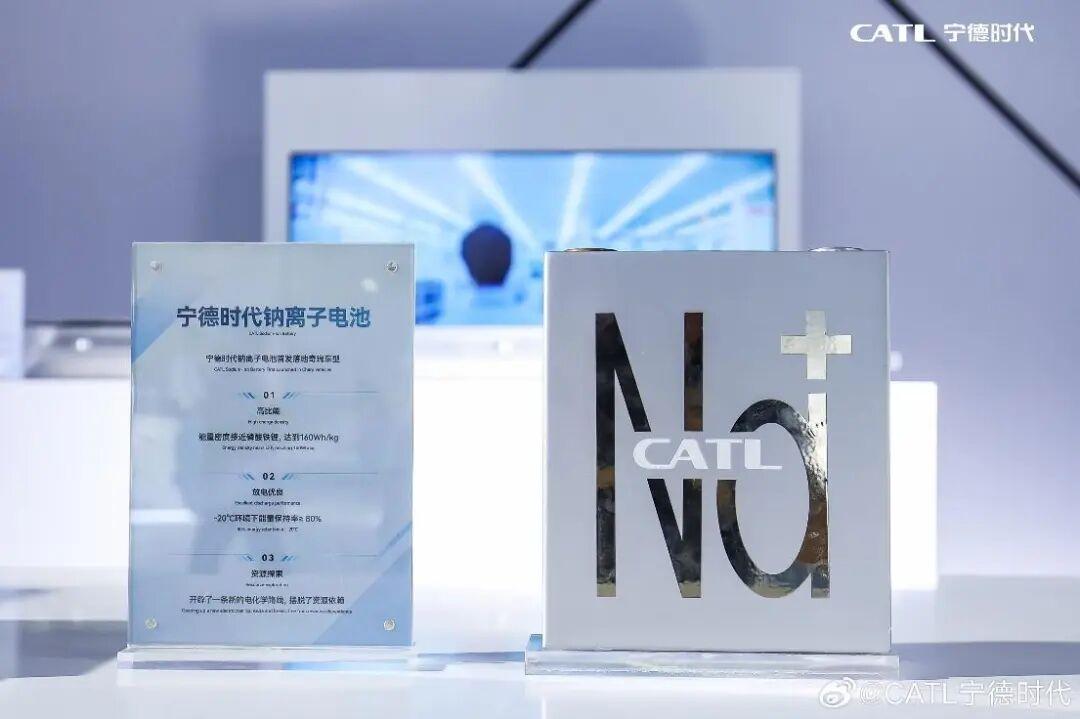
Contemporary Amperex Technology Co., Limited (CATL), the world's largest battery manufacturer, has confirmed that a series of sodium-ion battery products will enter large-scale production this year. The announcement was made by CATL Chief Scientist Wu Kai, who highlighted sodium-ion chemistry as a compelling alternative to lithium-ion technology due to its more abundant raw material supply and lower production costs.
The sodium-ion power battery in question was publicly unveiled last year and has since received certification under China's new national standards. According to the company, the cell delivers an energy density of 175 Wh/kg and supports 5C ultra-fast charging, enabling significantly shorter charge times compared to conventional lithium-ion alternatives.
CATL states the battery achieves a cycle life of 10,000 charge-discharge cycles and has passed a rigorous battery of safety tests — including multi-directional crush and nail-penetration tests — without catching fire or exploding. These results are being positioned as evidence that sodium-ion chemistry can meet the same safety bar as established lithium-ion products.
Cold-weather performance, long a weak point for sodium-ion chemistry, also appears to have been substantially addressed. CATL reports the battery retains 93% of its usable capacity at -30°C, and can sustain highway driving at 120 km/h even when the state of charge falls as low as 10% — directly targeting the low-temperature energy fade that has historically limited sodium-ion adoption in electric vehicles.
CATL has indicated it plans to ramp sodium-ion battery supply to a commercial scale in the fourth quarter of 2025. Rather than targeting a single market, the company intends to pursue deployment across four sectors simultaneously:
Battery-swapping services — supporting the growing network of swappable EV battery stations
Passenger vehicles — offering a lower-cost option for mainstream electric car models
Commercial vehicles — addressing cost sensitivity in trucks, buses, and logistics fleets
Energy storage — leveraging abundant sodium resources for grid-scale stationary applications
The multi-sector approach reflects a broader industry thesis: that sodium-ion batteries are not a direct replacement for high-energy-density lithium-ion cells, but rather a cost-competitive complement suited to applications where raw material abundance and price stability matter more than peak energy density.
Beyond sodium-ion, Wu Kai also offered a glimpse into CATL's longer-term research priorities. He indicated the company intends to focus future development efforts on lithium-air battery technology, which carries a theoretical energy density five to ten times higher than current lithium-ion cells. Wu framed lithium-air as the defining competitive frontier for next-generation battery technology — though the path from laboratory chemistry to commercial product remains a formidable engineering challenge the entire industry is racing to solve.
CATL has targeted Q4 2025 for the start of large-scale commercial supply of its sodium-ion battery products, with applications spanning passenger EVs, commercial vehicles, battery-swapping networks, and stationary energy storage.
CATL's sodium-ion cell reaches 175 Wh/kg, which is lower than premium lithium-ion cells but competitive for cost-sensitive applications. The key advantage lies in lower raw material costs and greater resource abundance rather than outright energy density.
Yes. CATL reports the battery retains 93% of usable capacity at -30°C and can sustain 120 km/h driving even at a 10% state of charge in sub-zero conditions — performance the company describes as a direct solution to cold-weather energy fade.
Lithium-air batteries use oxygen from the air as a cathode reactant, giving them a theoretical energy density five to ten times that of current lithium-ion cells. CATL's Chief Scientist identified it as the next major battleground in battery research, though commercialization remains years away industry-wide.
CATL's confirmation of sodium-ion mass production in 2025 represents a meaningful step toward diversifying the global EV supply chain away from lithium dependence. With 175 Wh/kg energy density, 5C fast charging, a 10,000-cycle lifespan, and proven cold-weather resilience, the company's sodium-ion offering is technically competitive for a wide range of real-world use cases.
Whether the Q4 2025 ramp proceeds on schedule — and how quickly sodium-ion penetrates the passenger vehicle market specifically — will be closely watched by automakers, fleet operators, and energy storage developers worldwide as the industry weighs its options beyond lithium-ion chemistry.
Next:SVOLT 285kWh C&I ESS: Dual-side liquid cooling & CTR redefine storage economics
Previous:Sungrow Powers Zambia's Largest Single Solar PV Project at 136 MW Itimpi Phase II
Contact Person: Miss. Elsa Liu
| WhatsApp : | +8617763274209 |
|---|---|
| Skype : | +8617763274209 |
| WeChat : | 17763274209 |
| Email : | Elsa@lifepo4-battery.com |
