
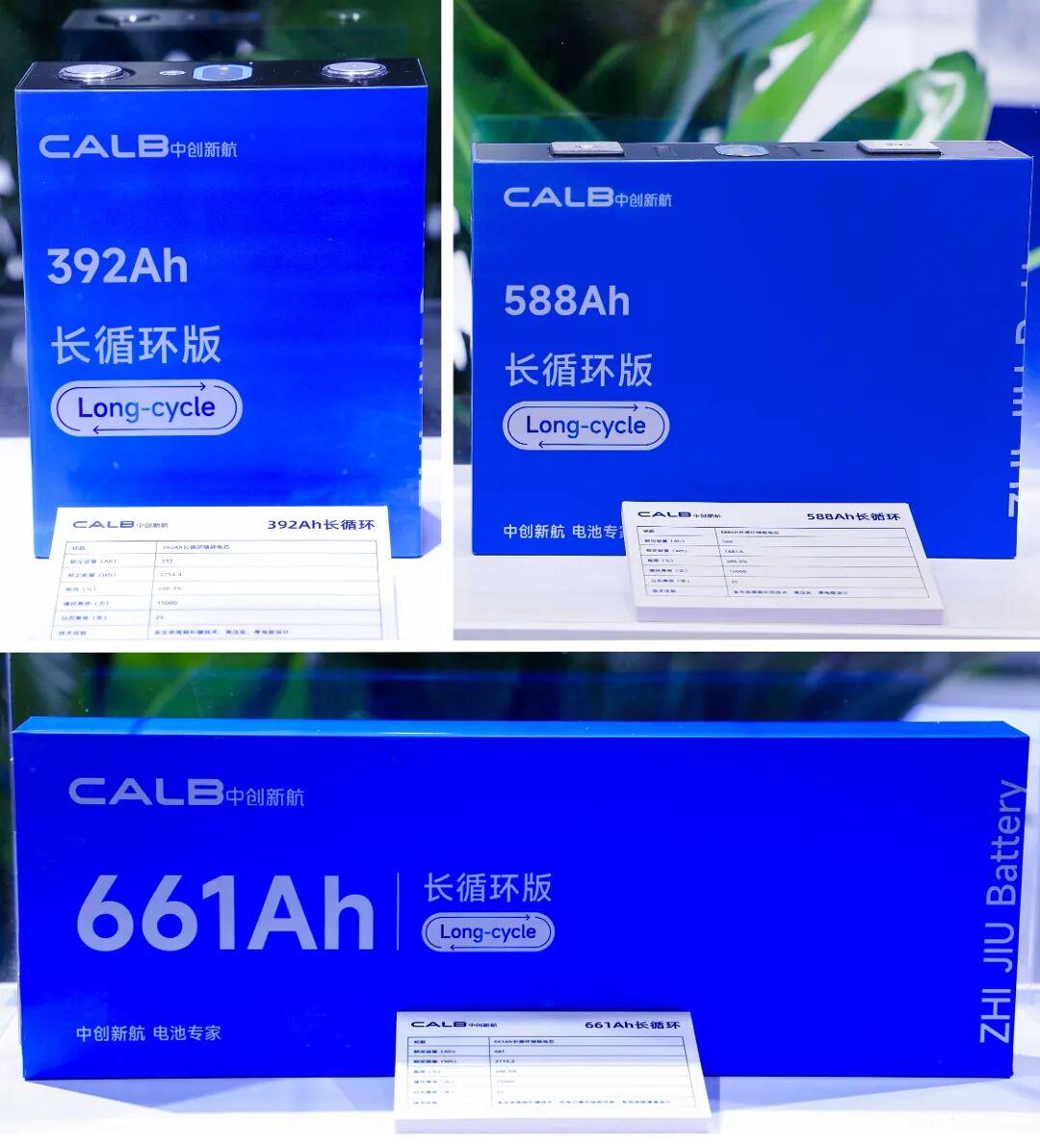
BEIJING – On the opening day of the 14th Energy Storage International Summit and Exhibition (ESIE 2026), CALB made a significant appearance under the banner of “AI + Energy, Zero-Carbon Solution Provider.” In a product launch held on April 1, the battery manufacturer officially introduced its next-generation “Zhijiu” series long-cycle energy storage battery cells, available in three capacities: 392Ah, 588Ah, and 661Ah. The company also unveiled the “Zero Carbon Ark” intelligent energy management platform in partnership with Bingwu Digital Intelligence.
The newly launched “Zhijiu” series (meaning “long-lasting” in English) encompasses three variants — 392Ah, 588Ah, and 661Ah — developed based on CALB’s 314Ah Gen2.0 ultra-long-cycle battery cell, which has accumulated one year of mass production and delivery experience. The company reports that the new cells achieve a cycle life of 15,000 times and a calendar life of 25 years, with zero capacity degradation in the first three years of operation.
⚡ Technology deep dive: The extended cycle life is enabled by systematic optimization of the cathode, anode, and electrolyte. CALB has taken an industry lead in scaling up lithium replenishment (pre-lithiation) technology. On the cathode side, a lithium-supplementing additive boosts initial capacity and cycling stability. The proprietary electrolyte additives improve the stability of the cathode-electrolyte interphase (CEI) film, effectively suppressing side reactions between the cathode material and the electrolyte while mitigating gas generation issues commonly seen during lithium replenishment — achieving “lithium replenishment without gas evolution.” On the anode side, a high-strength granulation process combined with artificial SEI interface design reinforces structural stability.
Targeting applications such as renewable energy integration, grid fluctuation regulation, AI data centers (AIDC), and zero-carbon industrial parks, the Zhijiu series is designed to withstand high-frequency charge/discharge demands in modern energy storage systems. The 25-year lifetime aligns with the industry goal of “synchronized lifespan for PV and storage,” reducing the need for mid-life battery replacements.
During the same launch event, CALB and its partner Bingwu Digital Intelligence jointly presented the “Zero Carbon Ark” energy management platform, a software-and-data foundation positioned as a smart energy hub for parks and cities. The platform leverages AI algorithms to aggregate data across generation, grid, load, and storage (source-grid-load-storage) segments, enabling coordinated optimization and building a true urban energy nexus.
On the deployment roadmap, CALB adopts a progressive “park-to-city” strategy, starting with zero-carbon parks as demonstration units before scaling toward city-wide orchestration. The ultimate goal is a “Zero Carbon Smart City” with intelligent dispatch and full decarbonization. According to the company, the “Zero Carbon Ark” has already completed market validation through full-scenario zero-carbon ecosystem pilot projects, and is now entering the batch delivery phase.
At the exhibition booth, CALB also delivered an in-depth presentation titled “Zero Carbon Ark · Smart Future – CALB AI+Energy Enabling a New Zero-Carbon Park Ecosystem”, sharing technical details and real-world case studies from its zero-carbon solution portfolio.
With the global shift toward renewable-heavy grids and rising demand for long-duration storage, CALB’s Zhijiu series directly addresses pain points around cycle life and capacity retention. The combination of 15,000 cycles and a 25-year lifespan effectively supports “PV-storage parity” over the asset lifetime. Meanwhile, the Zero Carbon Ark platform showcases how battery OEMs are moving beyond cell manufacturing into AI-powered energy services — a critical evolution as cities and industrial parks pursue net-zero targets.
Analysts at ESIE 2026 noted that CALB’s emphasis on both hardware longevity and software-defined energy management could set a new benchmark for integrated zero-carbon infrastructure. The company’s pre-lithiation technology, already deployed at scale, differentiates its cells from conventional LFP products that often suffer from capacity fade after heavy cycling.
Next:REPT BATTERO Unveils Wending 588Ah & Powtrix at ESIE 2026
Previous:CALB Starts Mass Production of Aviation-Grade Battery for Flying Cars
Contact Person: Miss. Elsa Liu
| WhatsApp : | +8617763274209 |
|---|---|
| Skype : | +8617763274209 |
| WeChat : | 17763274209 |
| Email : | Elsa@lifepo4-battery.com |
