
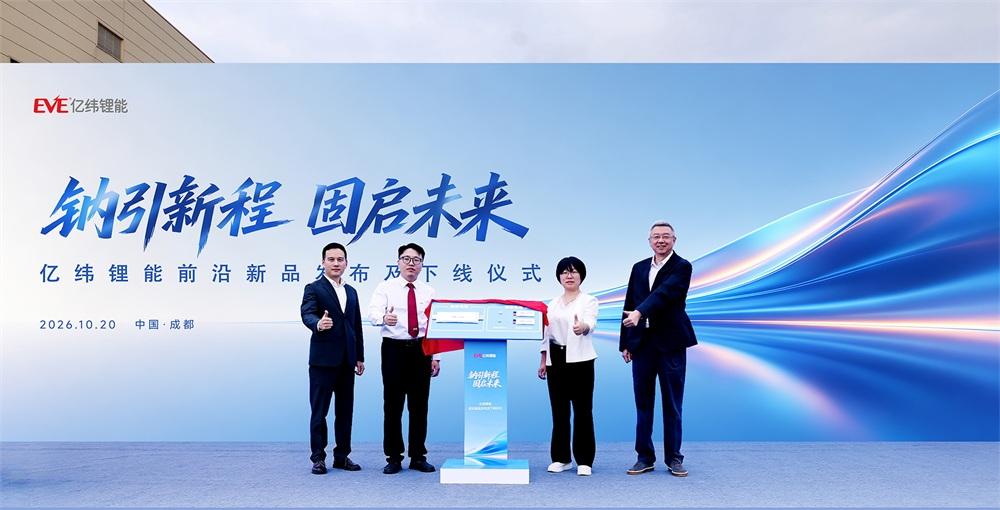
EVE Energy held a frontier product launch and roll-off ceremony at its Chengdu base on Oct. 20, unveiling the Longquan No.3 2.0 all-solid-state battery and a sodium-ion battery solution designed for electric two-wheelers. Three products—Longquan No.3 2.0, a polyoxy all-solid-state battery and a solid-liquid battery—rolled off the line at the event.
Dr. Liu Jincheng, chairman of EVE Energy, the company’s core management team, industry-chain partners, customer representatives and media guests attended the ceremony, which the company said marked a new stage in the industrialization of its frontier technologies.
The Longquan No.3 2.0 all-solid-state battery targets the brain-computer interface sector and implantable medical power supplies. The technology could help patients with paralysis or speech loss restore functions, giving it disruptive value in brain-controlled interaction, according to the company.
Non-invasive BCI solutions currently face limits such as insufficient signal accuracy, limited functions and reliance on external head-mounted devices, making large-scale deployment difficult. Invasive solutions, with stronger signals and lower noise, can enable deeper human-machine interaction and reconstruction of visual and auditory functions, and are regarded as the ultimate technical form for practical BCI. However, cranial implant scenarios impose strict power-supply requirements: biocompatibility, long-term sealed leakage prevention, no rejection, and extreme volumetric energy density in a very small space. Traditional liquid lithium batteries cannot simultaneously deliver high safety and high energy density, a core bottleneck for clinical deployment.
Longquan No.3 2.0 adopts an anode-free technical route and integrates special-shaped battery design and insulation cofferdam technology. Inside a titanium coin cell with a diameter of 23 mm and thickness of 4 mm, it achieves a volumetric energy density of 1,045 Wh/L, 40% higher than traditional liquid batteries, the company said. This allows more acquisition channels within limited cranial space, longer endurance and smaller devices, reducing implant trauma. By replacing liquid electrolyte with solid electrolyte, it removes leakage and thermal runaway risks at the source and meets safety standards for long-term stable operation of implantable devices.
At the ceremony, EVE Energy signed strategic cooperation agreements with Jingyu Medical and Sichuan Provincial People’s Hospital to connect R&D, industrialization and clinical application, aiming to advance implantable BCI toward accessible clinical use and bring safe, miniature and long-lasting energy solutions to more health scenarios.
For light-duty power batteries, EVE Energy introduced a sodium-ion solution for electric two-wheelers to address industry pain points such as short service life, poor storage performance, reduced low-temperature range and limited safety. Based on the characteristics of sodium-ion materials, the product offers four systematic advantages. Its cells have a cycle life of up to 10,000 cycles; based on charging every two days, it can be used stably for more than 25 years, enabling “vehicle and battery same life.” It supports discharge temperatures from -40°C to 60°C, with discharge retention above 93% at -20°C, suiting use across northern and southern regions and all seasons. After being fully discharged and stored for one year, capacity recovery exceeds 98%, allowing normal use after long idle periods. It also resists fire and explosion under nail penetration, cutting and crushing, with no thermal runaway under overcharge or short circuit, according to the company.
Contact Person: Miss. Elsa Liu
| WhatsApp : | +8617763274209 |
|---|---|
| Skype : | +8617763274209 |
| WeChat : | 17763274209 |
| Email : | Elsa@lifepo4-battery.com |
