
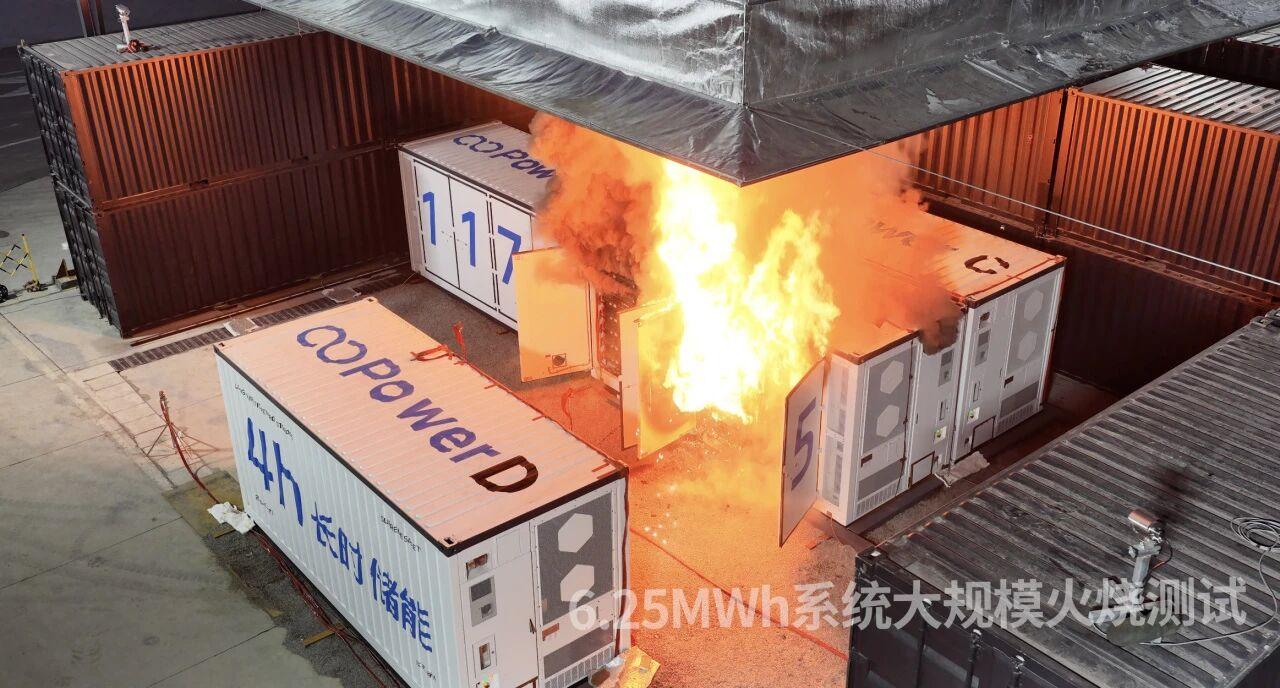
HiTHIUM has successfully carried out the world’s first publicly witnessed large-scale fire test of a 6.25MWh, 4-hour long-duration energy storage (LDES) system based on kiloampere-hour (kAh) battery cells. The test was conducted with full on-site oversight from UL Solutions, U.S. Authorities Having Jurisdiction (AHJs), and professional fire protection engineers, and was executed in strict alignment with the latest UL 9540A (2025) and NFPA 855 (2026) requirements.
According to the test outcomes, the high-energy-density 6.25MWh storage system demonstrated stable, controllable safety behavior even under extreme fire conditions. The results represent a significant step forward in validating safety performance at higher energy thresholds, reinforcing confidence in the large-scale deployment of next-generation LDES solutions.
Following its earlier open-door fire test of a 5MWh system, HiTHIUM advanced its validation efforts by targeting the higher-capacity ∞Power 6.25MWh LDES platform, built around its proprietary ∞Cell 1175Ah battery cell. The objective was to assess system-level safety performance under substantially increased energy density.
The test setup was intentionally designed to represent worst-case scenarios. Container doors remained fully open throughout the event, creating continuous oxygen-rich combustion conditions. Adjacent containers were positioned back-to-back and side-by-side with a minimal 15 cm gap. The system was charged to 100% state of charge, and all active fire suppression measures were disabled, leaving intrinsic safety design as the sole line of defense.
To mitigate the compounded risks associated with ultra-large-capacity cells and high-density systems, HiTHIUM deployed a multi-layer safety framework covering the cell, module, and system levels. Built around the principles of “controlled release, effective protection, and structural resistance,” the fire test examined three core safety challenges.
During thermal runaway of the 1175Ah cells, managing rapid energy release was critical. HiTHIUM applied a three-dimensional airflow and directional venting design, complemented by a dual pressure-relief valve configuration at the module level. This approach allowed gases to be discharged efficiently and predictably, preventing pressure accumulation. Throughout the test, no explosions or debris ejection were recorded.
Despite sustained open-door combustion and extremely close container spacing, the system successfully confined the fire to a single battery unit. Fire-resistant module covers, reinforced steel housings, and insulated multi-layer container structures prevented heat transfer to neighboring systems. Temperature readings from adjacent containers remained well below critical safety limits, confirming effective thermal isolation.
To endure extended high-temperature stress, the ∞Power 6.25MWh system incorporated reinforced steel frames, internal stiffeners, and dual-layer partitioning. Post-test inspections showed that the affected container maintained structural integrity, with no major deformation or collapse observed after prolonged combustion.
The successful completion of this test marks a notable milestone in global energy storage safety verification, particularly for LDES systems utilizing kAh-scale battery cells. It demonstrates that safety performance can be maintained as system capacity scales from 5MWh to 6.25MWh and beyond.
As energy storage systems continue to grow in size and importance, HiTHIUM is positioning LDES as a long-term strategic focus, emphasizing rigorous engineering standards and extreme-condition validation. By actively contributing to the evolution of global safety frameworks and collaborating with industry stakeholders, the company aims to support the deployment of larger, more reliable, and safer energy storage infrastructure—helping accelerate a stable and sustainable global energy transition.
Next:CATL and Changan Debut First Mass-Produced Sodium-Ion Battery Car
Previous:Sungrow 1+X 2.0 Cuts PV Plant Repairs to One Hour in Field Test
Contact Person: Miss. Elsa Liu
| WhatsApp : | +8617763274209 |
|---|---|
| Skype : | +8617763274209 |
| WeChat : | 17763274209 |
| Email : | Elsa@lifepo4-battery.com |
