
In utility-scale solar plants, a failure in a central inverter can stop a multi-megawatt unit entirely. The process from fault detection to resolution often spans days, leading to significant energy losses. The difficulty and downtime associated with maintaining large inverters have long been industry hurdles.
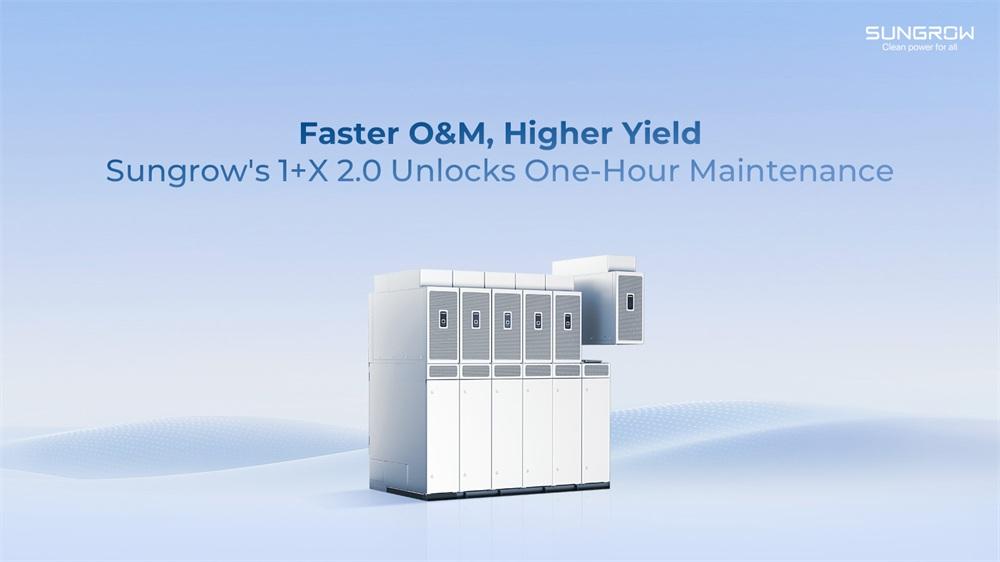
Addressing this, Sungrow has integrated intelligent fault diagnostics with a separable modular design in its 1+X 2.0 modular inverter. This combination targets slow fault identification and repair cycles tied to manufacturer dispatch. To demonstrate its real-world efficacy, Sungrow recently collaborated with TÜV Rheinland on a field test at the Tuanfeng plant in Hubei Province, China.
During the test, an IGBT fault was simulated. The system identified the specific faulty component within three minutes, displaying details and repair instructions via its backend. Two technicians then used specialized tools to remove the front cover, disconnect terminals, swap the faulty module with a spare, and recommission the unit. Full grid reconnect was achieved in 58 minutes.
"Time saved in maintenance directly translates to higher energy yield," noted Tian Xingxin, a TÜV Rheinland certification expert who observed the test. "The 1+X 2.0's smart diagnosis and modular design compress repair from days to about an hour, redefining utility PV plant maintenance."
For comparable faults, traditional methods can take dozens of times longer. Previously, crews awaited manufacturer specialists for assessment and repair, often extending downtime to weeks and compounding generation losses.
The solution stems from Sungrow's integrated approach to persistent industry challenges.
Software: AI-Powered Diagnostics Minimize Downtime
Conventional inverter repair relies heavily on manufacturer engineers, causing delays, especially at remote sites. The 1+X 2.0's system employs neural networks, machine learning, and expert rules for automatic, precise fault identification within seconds, providing actionable guidance. It currently diagnoses over 20 common faults—including IGBT, reactor overheating, and PDP issues—with over 96% accuracy, covering core maintenance needs. The system continuously learns from operational data, enhancing future diagnostic precision.
Hardware: Modular, Plug-and-Play Design Simplifies Replacement
Repairing failed core components like IGBTs in traditional inverters is complex and slow. The 1+X 2.0 consolidates these into compact, plug-and-play inverter modules. Each module weighs 105 kg—lighter than many string inverters—enabling swift on-site replacement by two personnel with simple tools, achieving repairs in roughly one hour.
As PV plants grow in scale and complexity, traditional maintenance faces rising cost and efficiency pressures. By fusing intelligent diagnostics with a separable modular design, the 1+X 2.0 offers a refined pathway. It elevates plant efficiency, reliability, and lifecycle value through precise fault detection and rapid hardware swap, setting a new benchmark for operational sustainability in utility solar.
Next:HiTHIUM Validates 6.25MWh LDES Safety in World-First Open-Door Fire Test
Previous:Tesla Plots $20 Billion Battery & Lithium Push Amid Growth Shift
Contact Person: Miss. Elsa Liu
| WhatsApp : | +8617763274209 |
|---|---|
| Skype : | +8617763274209 |
| WeChat : | 17763274209 |
| Email : | Elsa@lifepo4-battery.com |
