
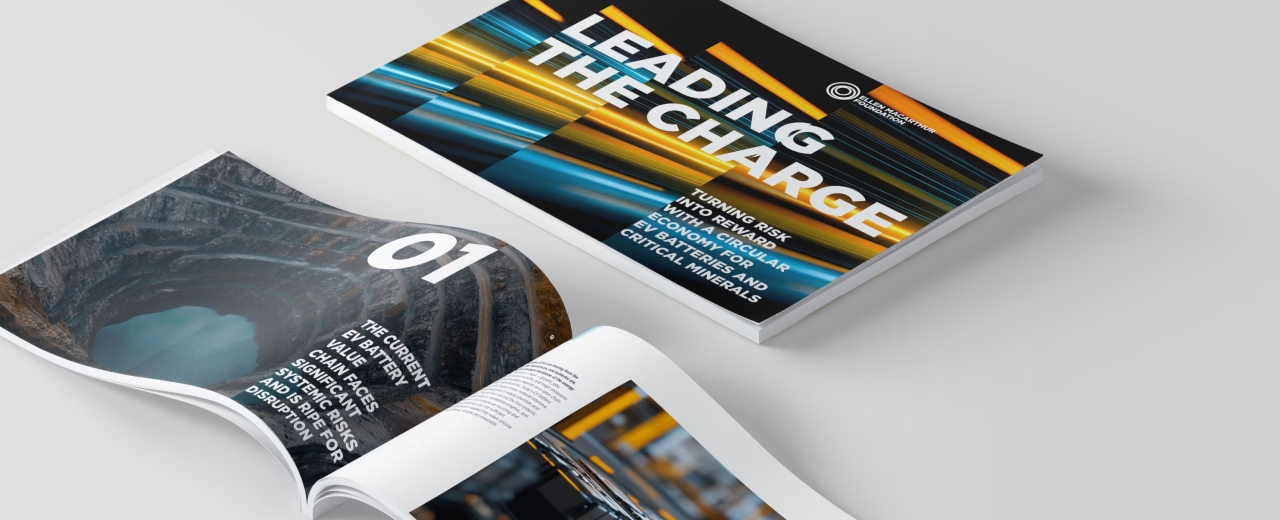
[Dateline: DAVOS, Switzerland] — During the World Economic Forum Annual Meeting 2026, the Ellen MacArthur Foundation released Leading The Charge, a pivotal whitepaper that establishes the first actionable, integrated roadmap for a circular electric vehicle (EV) battery value chain. Developed in close collaboration with CATL, the report represents a significant milestone in the partnership between the battery giant and the Foundation, aiming to transform industry risks into circular opportunities.
A Collaborative Industry Roadmap
The report is the result of consultation with over 30 leading organizations across the ecosystem—including logistics and automotive heavyweights like DHL, Volvo, and JLR, as well as NGOs. As a founding strategic partner of the Foundation’s Critical Minerals Mission, CATL played a central role in translating circular economy concepts into practical operational steps. The resulting framework aligns with CATL’s Global Energy Circularity Commitment and its objective to decouple battery sector growth from the extraction of virgin raw materials.
The whitepaper argues that a circular battery system offers multi-faceted benefits: environmental, economic, and strategic. By maintaining batteries and critical minerals in circulation across multiple lifecycles, the industry can reduce emissions, lower material costs, and create new revenue streams. Furthermore, this approach is cited as a key factor in strengthening supply chain resilience and ensuring equitable distribution of economic value globally.
Five Pillars of a Circular System
To achieve these goals, the report outlines five interdependent "bright spots" or actions required to maintain high-value utility for battery materials:
Design: Engineering batteries specifically for circularity rather than disposal.
Service Models: Rethinking batteries within optimized energy-mobility ecosystems.
Asset Management: Scaling business models that treat batteries as long-term assets.
Infrastructure: Co-investing in regional circular infrastructure.
Ecosystem: Enabling operations through unified data, standards, and policy.
Industrial Application and Scalability
According to the report, CATL is currently implementing these system-level actions. By decoupling the battery from the vehicle, CATL treats batteries as centrally managed assets, which facilitates scheduled maintenance and predictable end-of-use returns. The company currently supports over 1,000 passenger-vehicle and 300 commercial-vehicle battery swap stations within a network of 100 partners.
This integration supports high-efficiency recycling. CATL reports recovery rates of 99.6% for nickel, cobalt, and manganese, and 96.5% for lithium, with processing capacities approaching 270,000 tonnes annually. Additionally, the deployment of sodium-ion technology—which uses abundant materials and lowers lifecycle carbon emissions by up to 60%—further reinforces their circular strategy.
Leadership Commentary
Jiang Li, Vice-Chairman and Board Secretary of CATL, described the report as a "major milestone," noting that circular systems must now be "scaled across regions, industries, and applications."
Wen-Yu Weng, executive leader for critical minerals at the Ellen MacArthur Foundation, added that as EV adoption grows, a circular economy is "no longer optional—it is essential to affordability, resilience, and long-term growth."
This agenda underpins CATL’s broader roadmap toward carbon neutrality across its full value chain by 2035. The partners indicate that the next phase of collaboration will focus on stress-testing these approaches in real-world environments to validate how design, usage, and recycling loops function at scale.
Next:EU Battery Storage Report 2025: Record 27.1 GWh Growth & Market Analysis
Previous:HiTHIUM Debuts 8-Hour LDES Tech at WFES & Signs Egypt Deal
Contact Person: Miss. Elsa Liu
| WhatsApp : | +8617763274209 |
|---|---|
| Skype : | +8617763274209 |
| WeChat : | 17763274209 |
| Email : | Elsa@lifepo4-battery.com |
